

Disrupting tRNA modifications to target mitochondrial vulnerabilities in drug-resistant leukemia cells

Read More
Authors

Cornelius Pauli, Michael Kienhöfer, Maximilian Felix Blank, Oguzhan Begik, Christian Rohde, Sarah Miriam Naomi Zimmermann, Laura Werner, Daniel Heid, Fu Xu, Katharina Weidenauer, Sylvain Delaunay, Nadja Krall, Katrin Trunk, Duoduo Zhao, Fengbiao Zhou, Laia Llovera, Alexane Ollivier, Anke Heit-Mondrzyk, Uwe Platzbecker, Claudia Baldus, Hubert Serve, Martin Bornhäuser, Cathrine Broberg Vågbø, Salvador Aznar Benitah, Jeroen Krijgsveld, Eva Maria Novoa, Carsten Müller-Tidow, Michaela Frye

Key Points

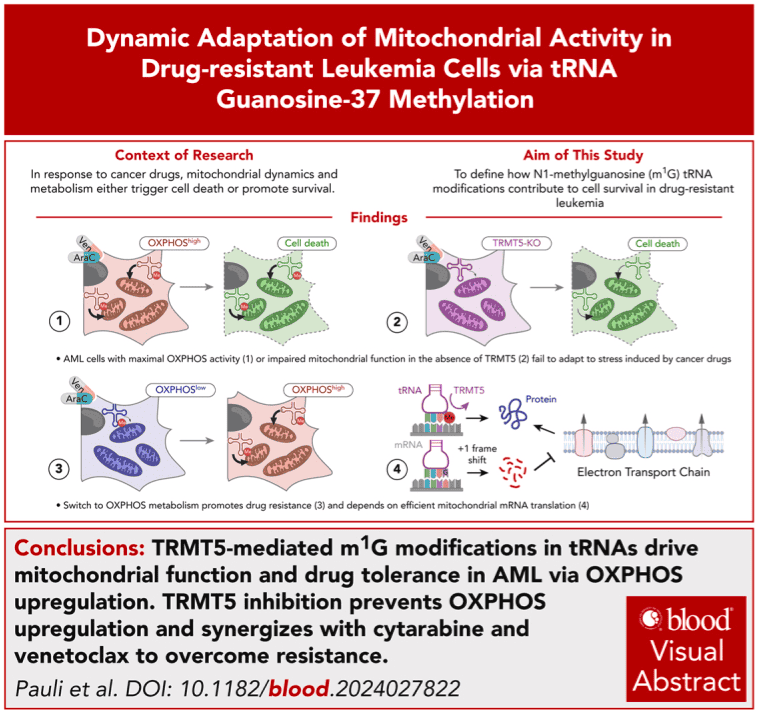
  • TRMT5-mediated N1-methylguanosine tRNA modifications drive mitochondrial function and drug tolerance in AML via oxidative phosphorylation.
  • TRMT5 inhibition prevents oxidative phosphorylation upregulation and synergizes with cytarabine and Ven to overcome resistance.
Abstract

Dysregulated RNA modifications contribute to cancer progression and therapy resistance, yet the underlying mechanism often remains unknown. Here, we perform CRISPR-based synthetic lethality screens to systematically explore the role of RNA modifications in mediating resistance to antileukemic drugs. We identify the tRNA methyltransferase 5 (TRMT5)–mediated formation of N1-methylguanosine (m1G) in the transfer RNA (tRNA) anticodon loop as essential for mediating drug tolerance to cytarabine and venetoclax (Ven) in acute myeloid leukemia (AML). TRMT5 methylates nearly all mitochondrial and nuclear tRNAs with a guanosine at position 37, but its role in promoting drug tolerance specifically depends on its mitochondrial function. TRMT5 is essential for the dynamic upregulation of mitochondrial messenger RNA translation and oxidative phosphorylation, which are critical for sustaining drug tolerance in leukemia cells. This mitochondrial dependency correlates with therapy outcomes in patients with leukemia: lower expression of electron transport chain genes is linked to poorer outcomes in a cohort of nearly 100 patients with AML undergoing first induction therapy. Finally, we demonstrate that targeted depletion of the TRMT5 protein using a conditional degron, in conjunction with cytarabine and Ven treatment, synergistically induces cell death in drug-tolerant AML cells. Thus, our study reveals TRMT5 as a promising drug target for therapy-resistant leukemia.

Visual Abstract

Fig. 1: MDEs in patients with smoldering multiple myeloma according to high, low/intermediate or unknown risk status.
Published

2025

More Details

WordPress Cookie Notice by Real Cookie Banner